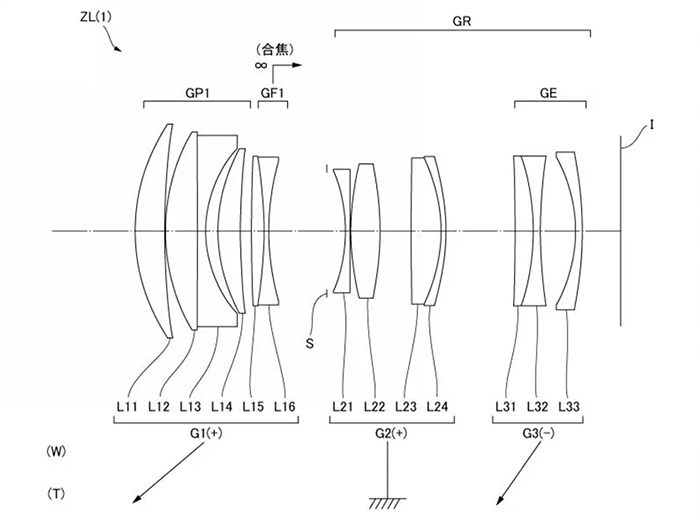
New patent reveals the optical design for a 24mm f/2.0 lens with a larger-than-full-frame image circle.
A newly published patent details a 24mm f/2.0 optical design with an image circle large enough to cover sensors bigger than full-frame—specifically the 44×33mm format used by the Fujifilm GFX and Hasselblad X2D systems. What could this mean in practice?
Possible implications
Sigma designed a 24mm f/2.0 with a very large image circle to deliver exceptional image quality on full-frame with minimal digital correction.
Sigma may be outsourcing or licensing the design for Fujifilm- or Hasselblad-branded lenses.
Sigma could be preparing a native lens for GFX (44×33mm) or Hasselblad’s medium-format mount.
Sigma might be laying groundwork for its own medium-format system.
It could simply be a defensive patent to protect IP without immediate product plans.
You can make up your mind—but I’d certainly love to see Sigma bring lenses to both the Fujifilm GFX and Hasselblad X2D ecosystems.
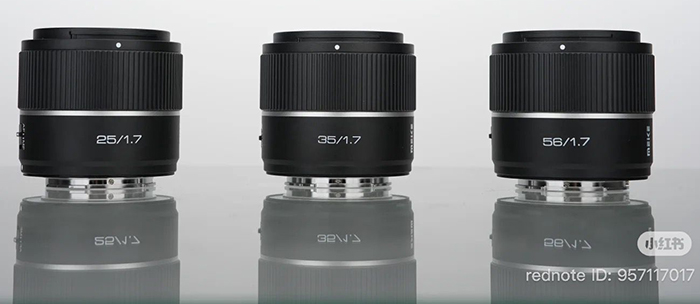
7Artisans is teasing a new lightweight, all-in-one APS-C autofocus lens that fits in your palm. Here’s what we know so far:
Featherweight 180 g body — pocketable and easy to carry
Three focal-length options tailored for street photography
APS-C design with autofocus
Multiple mounts planned (official list pending)
We’ll update this post as soon as the full specifications, mount list, and pricing are official.
Another teaser angle emphasizing the compact form factor. Image credit: 7Artisans / Weibo.
FAQs
How much does it weigh?
Approximately 180 g.
What sensor format is it for?
APS-C.
Does it have autofocus?
Yes, autofocus is confirmed.
Which mounts will be supported?
Multiple mounts are planned; the official list has not been announced yet.
Who is this lens aimed at?
Street photographers and anyone who wants a compact, pocketable, do‑it‑all lens.
What to expect next
Expect official details on focal lengths, optical construction, mount compatibility, pricing, and availability. We’ll update this page the moment specs drop.
With the holidays approaching and year-end projects piling up, video noise, soft focus, compression artifacts, or slow internet can slow down post-production. Aiarty Video Enhancer works offline to process mirrorless footage, documentaries, and family videos.
Unlike cloud-based tools, Aiarty Video Enhancer processes files locally for privacy and speed. Recent updates include the Strength Slider for controlled enhancement and Step Mode for high-resolution footage. Upcoming features such as color consistency and YUV 422/444 export are included in the Lifetime License.
Lifetime License with Holiday-Exclusive Discount
Save 36% on the Lifetime License, plus use code XMASSAVE for an extra $5 off—valid until Jan. 10th, 2026. The license includes unlimited free updates and can be installed on up to three computers (Mac or Windows). No subscription or extra fees.
“After testing many video enhancers, I feel Aiarty is the winner. It has different modes depending on the clip. One is designed for low light situations, which is very helpful. There is also a blend percentage control for softening the result.”
— John Kempt, Artist
“I recently downloaded the trial and I am testing it for my YouTube channel workflow (Atmospheric/Cinematic content). The texture recovery on nature scenes is impressive compared to other tools I’ve used.”
— Tarcisio Resende, Content Creator (@ClassicalImmersion)
Aiarty Video Enhancer: Key Features at a Glance
Aiarty works entirely offline, supporting large or sensitive files and on-the-go editing. Key features include:
AI Upscaling & Denoising: Use moDetail-HQ v2 for fine textures or superVideo vHQ for heavy sensor noise. Includes a Strength Slider for manual refinement.
VRAM & Speed Optimization: Toggle between Turbo Mode for speed or Step Mode to reduce VRAM usage—essential for processing high-res footage on different hardware.
Pro Workflow Tools: Fully offline Batch Processing for large sets, plus SDR to HDR conversion and Frame Rate Boosting for smooth slow-motion.
Integrated Toolkit: Clean up audio with AI Audio Denoise and handle quick edits (cut, crop, rotate, color) without leaving the app.
Real-World Use Cases
Mastering Low-Light & Night Footage
Even with high-end mirrorless sensors like the Sony A7S III, ultra-high ISO footage can suffer from chroma noise and lost texture. Aiarty’s superVideo vHQ model removes artifacts while preserving natural grain and the original footage’s integrity.
The Strength Slider allows you to retain natural grain when needed.
Restoring Legacy & AI-Generated Footage
Bring 360p, 480p, or 720p footage into the modern era. Whether you are restoring family archives or upscaling AI-generated content, Aiarty recovers lost details to bring your vision into 4K focus.
High-Action & Outdoor Clarity
Action shots often suffer from motion blur or compression artifacts. Aiarty improves clarity and detail retention, even in high-frame-rate 240fps clips. “Footage recorded in FHD, 240fps, then upscaled to 4k using Aiarty Video Enhancer.” — A Red Dot Explorer, nature videographer
Try Aiarty for Your Holiday Projects
For 1080p footage from mirrorless or DSLR cameras, Aiarty restores texture and clarity when upscaling to 4K. Its offline workflow allows full control without relying on cloud services, integrating denoising, upscaling, and batch processing in one tool.
Unconfirmed: Reported Nikon ZR C details surfaced on Weibo.
Rumor alert: According to chatter on Weibo, the Nikon ZR C is expected to arrive in the fourth quarter of 2026. It’s said to target the entry‑level video/vlogging segment with a compact body similar to the Nikon Z30, omitting an electronic viewfinder and mechanical shutter to prioritize portability and price. The model reportedly aims to compete with the Canon EOS R50 V.
Release window and positioning
Timing: Rumored for Q4 2026
Format: APS‑C Nikon Z‑mount
Target user: Entry‑level video creators and vloggers
20‑megapixel APS‑C sensor (reportedly the same as the Nikon Z50 II)
EXPEED 7 image processor
Autofocus algorithm derived from Nikon Z9
No in‑body 5‑axis stabilization (IBIS)
Cropped 4K/60p video recording
1080p/120 video recording
Who is this rumored camera for?
If accurate, the ZR C would appeal to beginners and mobile creators who prioritize 4K/60p capture, reliable autofocus, and a lightweight body over features like an EVF or IBIS. Pairing with stabilized Z‑mount lenses would help compensate for the lack of in‑body stabilization.
Important disclaimer
This information is unconfirmed and may change. Treat all details as rumor until Nikon provides an official announcement.
FAQ (rumored)
When is the Nikon ZR C expected to be released?
Q4 2026, according to current rumors.
Will the Nikon ZR C have an electronic viewfinder?
No EVF is rumored, similar to the Z30’s EVF‑less design.
Does the Nikon ZR C include in‑body image stabilization (IBIS)?
IBIS is not expected. Use stabilized lenses to reduce shake.
What video modes are rumored?
Cropped 4K/60p and 1080p/120 are said to be supported.
How does it compare to the Canon EOS R50 V?
Positioning appears similar—an affordable, compact APS‑C vlogging camera—suggesting Nikon is targeting the same audience as Canon’s R50 V.
CP+ 2026 venue map: Sony’s booth footprint appears to be the largest.
The CP+ 2026 floor plan is now available. View the official map here: CP+ 2026 venue map.
Headline takeaway: Sony appears to occupy the largest booth footprint at this year’s show, scheduled for February 26–March 1, 2026, in Yokohama. As usual for CP+, the biggest booths cluster deeper into the hall. Alongside Sony, Canon, Fujifilm, and Nikon also command sizable spaces, signaling extensive displays and programming.
Booth size isn’t a verdict on quality, but it often enables more hands-on areas, stage sessions, and demo zones—useful for brands planning busy schedules or broader product-line coverage. Out of curiosity, here are estimated booth sizes relative to Sony (Sony = 100%):
Here is Petapixel’s 2026 BOLD camera prediction list. With “Bold” it means it’s mostly high risk speculation and many things will be wrong. Some of those “bold” statements are also kind of obvious and they will happen for sure in 2026:
Chris
Sigma will make Full Frame lenses for Nikon Z and Canon RF lenses
Chinese manufacturer will do a Leica styled rangefinder camera
Some AI camera is coming
Jordan:
OM Tough camera
Pentax digital camera (just something)
Richard Butler:
Nikon Z 9II
Nikon Z Rc (Nikon Z30 successor)
Nikon Z6IIIs (with mechanical shutter)
Sony A7rVI with partially stacked sensor
small MFT camera (New PEN or GF/GX or GM)
Panasonic S1H replacement as a sort of Sony FX3 competitor
HDR JPG from camera manufacturer
Jaron Schneider:
Nikon Z7 with partially stacked sensor
FujiFilm X-PRO4 with X-Trans 6 sensor in Q1. 40MP but faster sensor
FujiFilm X-H camera
Fujifilm TX fixed lens camera (two APS-C cameras side by side)
Mainly affordable lenses and less expensive lenses
CIPA has published global camera shipment data from Japanese manufacturers and there has been a spike in shipments. And as you can see from the graphs below while system camera sales are on par with last years performance the fixed lens camera market is really booming.
I am sure cameras like the Ricoh GRIV are selling hot right now!