
Venus Optics announced the World’s Widest Rectilinear Pancake: Laowa 10mm f/4 Cookie lens for Nikon/Leica/Sony/Canon/Fuji mount
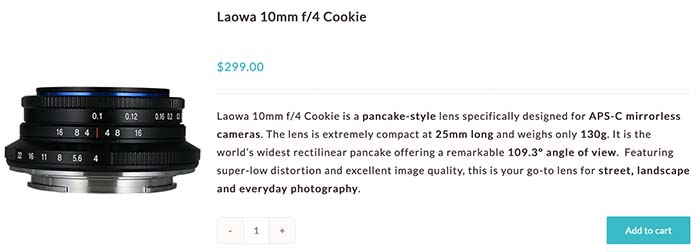
Venus Optics announced the new Laowa 10mm f/4.0 pancake lens (preorder here for $299).
Press text:
Venus Optics announces the launch of the new Laowa 10mm f/4 Cookie Lens for APS-C mirrorless cameras. It is one of the world’s widest rectilinear pancake lenses for APS-C cameras. At a cookie size of 25mm(0.98”) long and weighing only 130g(0.29lbs), it literally can be put in your pocket. Most of the wide-angle pancake lenses on the market are either fisheye or pinhole. They usually have obvious barrel distortion and inferior image quality. However, this new Laowa Cookie Lens is equipped with a high-performance optical design, featuring super-low distortion and optimized image quality to ensure users take full advantage of the mirrorless system – compact and capable. Laowa 10mm f/4 Cookie is a fun and mighty option for day-to-day content creators to carry around without burden, ideal for street, urban, landscape photography and everyday snapshots. The Lens has black and silver versions for multiple mounts including Canon RF, Nikon Z, Sony E, L mount and Fuji X to match with the camera body.
Key Features:
- Extremely Compact and Lightweight
- World’s Widest Rectilinear Pancake for APS-C
- Super-low Distortion
- High Optical Performance
- Stunning 10-Point Sunstar
- Close Minimum Focusing Distance
- Built-in Filter Thread
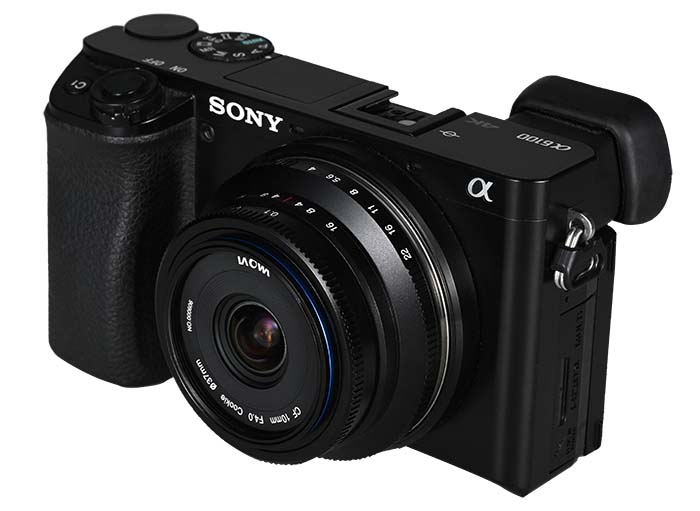
Extremely Compact and Lightweight
Laowa 10mm f/4 Cookie is a pancake-style lens specifically designed for APS-C mirrorless cameras. At just 25mm deep and weighing only 130g, you can use it with gimbals and shoot handheld easily. It’s almost like a body cap with function. With such discreet design and excellent portability, you will carry it anywhere and eventually shoot more.
World’s Widest Rectilinear Pancake
Featuring a remarkable 109.3° angle of view, Laowa 10mm f/4 Cookie is by far the world’s widest rectilinear pancake lens for APS-C on the market. With the advantages of the ultra-wide perspective and pocket-sized weight, this lens brings you a burdenless experience to capture epic moments in everyday life and explore the beauty in our surroundings.
Super-low Distortion
Most pancake lenses with a wide perspective are fisheye so heavy Barrel distortion would be expected. However, the Laowa Cookie is here to break the norm. The lens has excellent control of optical distortion. The horizontal and vertical straight lines are retained from corner to corner. As an ultra-wide-angle lens, this is essential not only to reduce the post-editing time but also to expand the possibility of genres you can do with this lens, from street and outdoor photography to shape-edged architectures and spectacular landscapes.
High Optical Performance
Laowa 10mm f/4 Cookie lens comes with 12 elements in 8 groups optical structure with 2 aspherical and 4 extra-low dispersion elements. Despite the light and compact design, the lens managed to deliver the impressive image quality and high contrast. The performance of chromatic aberration, flaring, and ghosting effects are optimized to support your day and night snapshots.
Stunning 10-point Sunstar
Built with 5 aperture blades, stunning 10-point Sunstar can be achieved easily when stop down.
Close Minimum Focusing Distance
The minimum focusing distance of Laowa 10mm f/4 Cookie is 10cm, allowing you to get super close to the subjects and create interesting wide-angle macro-like shots with nice separation between the object and background.
Built-in Filter Thread
Equipped with a 37mm filter thread for you to use screw-in filters directly. It is very convenient and cost-saving as no additional filter holder is required.
Pricing & Availability
Laowa 10mm f/4 Cookie is currently available to purchase via Venus Optics official website (http://www.venuslens.net/) and authorized resellers.
The US price for Laowa 10mm f/4 Cookie is USD299 for all mounts. Pricing varies in different countries.
Nikkei reports that Nikon will withdraw from the DSRL business. But Nikon quickly “sort of” denied it

The well known Nikkei news outlet reports that Nikon has withdrawn from the development of digital SLR cameras. No new digital single-lens reflex camera will appear in the future, and production and sales of existing models will continue for the time being. In summary:
Nikon Digital SLR Development Withdrawal
- Withdrew from the development of single-lens reflex cameras and concentrated on the development of mirrorless cameras
- Aiming to survive the camera by enhancing functions that smartphones do not have for professionals and core fans
- Existing models will continue to be produced and sold for the time being
But hours later Nikon Japan issued the following statement:
Today, some media outlets have reported that we have withdrawn from the development of single-lens reflex cameras, but this is speculation and not announced by us. We continue to produce, sell, and support digital SLR cameras, and we hope that our customers will continue to use them with peace of mind.
If you pay attention on the wording Nikon doesn’t mention it will continue the “development”. It only says it will keep “producing” which is kind of obvious. I am 100% sure the day is close Nikon will stop making DSLR cameras just like Sony and others did years before…
Phase One is teasing the launch of a new XT camera. Will it finally be mirrorless?

The big question is if this will be their first mirrorless camera….
Officially announced and available for preorder: Laowa 12-24mm f/5.6 Zoom for E, M, Z and RF mount
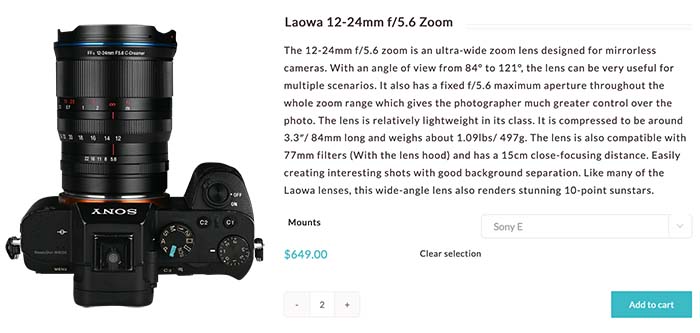
The new Laowa 12-24mm lens is now available for preorder at Venusstore (worldwide shipment). This is Dpreview’s take on the new Laowa:
CIPA data shows positives signs for the camera business. E-mount still the most popular system in Japan
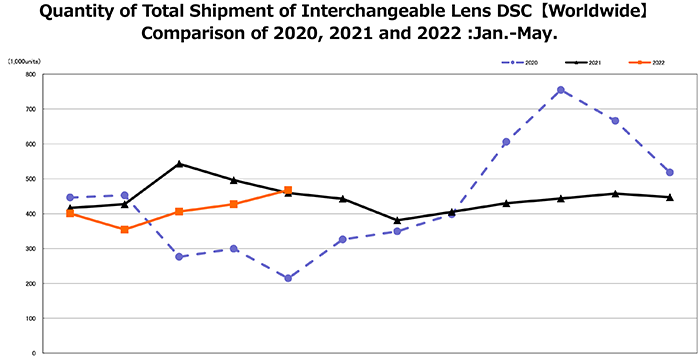
The latest MAY CIPA report is out and it shows that for the first time system camera shipments were higher than a year before. And BCN+R claims that the most popular mount in Japan is Sony’s E-mount with 32% of the market share. Followed by MFT with 17,1% and Canon EF with 12,3%.
Officially announced: New Nikon Z30 and 400mm lens
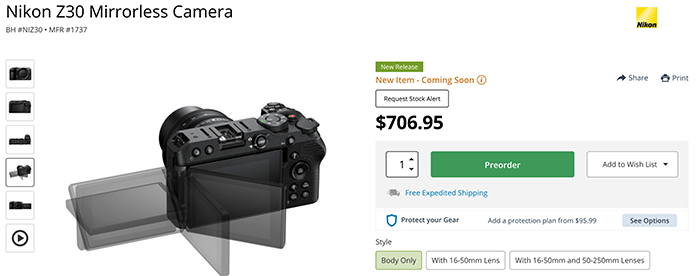
Nikon just announced the new Z30 (specs and info here) and the new 400mm lens (specs and info here).