DPReview TV: Best and Worst of 2018
Notable in this video: DSLR is absent :)

Mobile01 talked to Ricoh manager Noguchi Hiroshi and he made it clear that:
1) Ricoh will not make a Full Frame GR camera
2) Have no plan to make cameras with curved sensor
Here is the full google translated interview:
Q: The most important, but the most users will want to ask questions. All netizens want to ask, why is GRIII not a full-frame, but still apply APS-C, what is the consideration behind it?
A: GR is a snapshot camera of "Snap Shooting", so the most important purpose is to make a high-quality image while carrying a convenient product. We think APS-C is the most suitable choice.
Q: But the system in the past film era is also full-frame, but there is no way for digital users to do it?
A: 35mm is the specification that Leica has developed, but the digital era does not have to stick to this direction. Because GR is pursuing a camera suitable for snapshots, Snap Shooting is the main goal. In fact, in terms of technology, we can put the FF sensor in the GR, and it is about the same size as the GRIII, but there will be some compromises, such as the quality of the lens, or the operability. But we think APS-C is the most balanced choice.
At the current GRIII quality level, the photo can be enlarged to a size of B0 (100 x 141.4 cm), which can also be very fine.
Q: It has been rumored in the past that the new generation of GR will be born with a curved photosensitive element. Has this matter been discussed during development? In addition, when developing, is there no need to respond to market demand, that is, the sound of using full-size photosensitive elements?
A: The curved photosensitive element we have never considered, this thing is completely rumor.
As for the internal discussion of the full-frame, we are totally unconventional. If in the future, we want to add a new product line, then it may be possible to consider the use of full-frame photosensitive elements, but we are currently aiming at creating a "orthodox GR", so with the current product planning Said no such plan.
Many technology products will have the technical advantage. For example, for a while, the computer will see the highest CPU clock, but not everyone will need the highest specification, because not everyone will use it. The same is true for cameras, because not Full Frame is the best and most suitable thing. We must consider the user's situation and needs to create the best products. But we do know that fans with a lot of GRs really want the next generation to be full-frame.
Q: What is the technical impact and communication after Pentax joins? How many people are there in the team that develops GR?
A: The development department also needs to do the Theta 360 camera, but also the development of Pentax. So no one is completely responsible for the GR camera. Everyone is actually responsible for more than one project at the same time, so it is difficult to say how many people are responsible. GR. After Pentax entered, it was actually not a communication, because it was basically the same team.
Q: When was GRIII developed?
A: About a year and a half to two years ago.
Q: Who is leading the team when developing new products? Is it led by engineers and then marketed for planning; or is it that marketing asks engineers after collecting opinions from consumers? How is Ricoh Pentax done here?
A: Actually, there are both, but in GR, but for the product planning department, they have a very clear "GR philosophy". We will respect the needs of GR fans, but we will also look at the engineers. idea. However, GR will have its own adherence to the concept, not to say that the market has all the needs and put it all in.
Q: Is the volume of GRIII shrinking again, is it the demand of consumers? Because I have used the GR series myself, I think it is already a very mature camera, so I would like to ask if it is a technical display if the volume is reduced? Or is it a response to consumer demand?
A: Both have. The positioning of GR is a pocket machine, so miniaturizing the product is our priority.
Q: So if you can be smaller, would you want to do it even smaller?
A: Yes, but of course we must balance the operability. But at the moment we think this size is the best.

The image on tops shows the lens design difference between the EF and RF 35mm lenses. Thanks to the shorter flange distance the RF lens can be made much smaller while still having a superior image quality.
In an interview with DC.watch Canon engineers explained why having a shorter flange distance and large diameter matters. Just like Nikon also Canon claims lenses can be made of higher quality when the diameter is large because less in glass correction is needed.
It’s very interesting to learn from the interview that Canon actually considered to use the EF-M mount. But the smaller diameter wasn’t satisfying to achieve top image quality results. This seems like an indirect critic to Sony too which uses about the same diameter (Emount has 46mm and EOS-M 47mm).
–
Note: I edited this post and corrected some mistranslated part reported by the readers. Thanks!

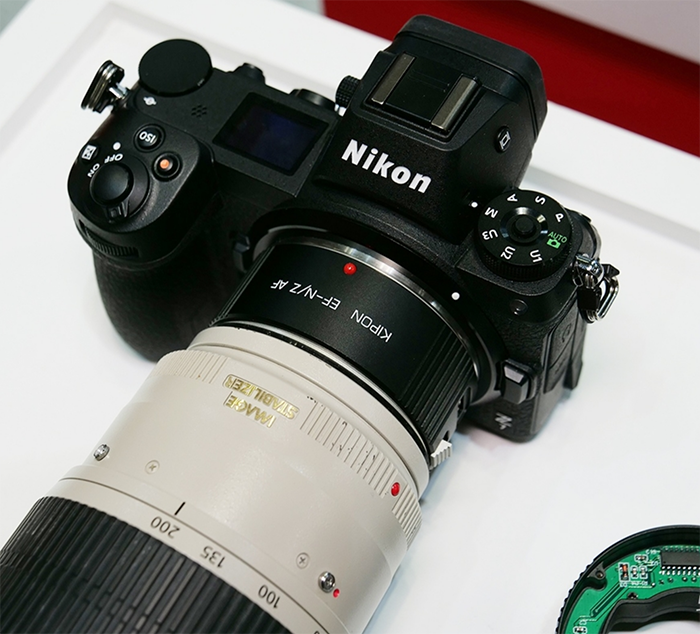
I think this might be the first “real world” image of the soon to belaunched massive 58mm f/0,95 lens mounted on the Z7. I wonder how many Z camera owners will actually buy that huge lens that is rumored to cost close to $6,000!
According to the source the lens “is coming in January 2019 most probably”
via Nikoneye.com

The Japanese store MapCamera shared the list of the ten most selling cameras from their store. This is not to be considered a valid source for a global trend anlysis. But still it’s interesting to see anyway :)

News8.de reports that Meyer Optik Görlitz got acquired by OPC Optic (another German company). There is a full german press text and below you can find the google tranlsated text. But two important news upfront:
1) Yes OPC Optic will now do Meyer Optik lenses again
2) No, if you had a lens on preorder on Kickstarter/indiegogo you will NOT get your money back. OPC Optic acquired the brand name but not the “net SE” company that is behind all that mess.Still, OPC Optic is considering you to give those people a discount on future lens purchases.
OPC Optics acquires trademark rights to Meyer Optik Görlitz following insolvency of Koblenzer net SE
– Entry into the consumer market for OPC Optics
– Brand should be filled with life as soon as possible
– Production and products are optimized and the portfolio streamlined
– Sales via classic distribution – no crowdfunding, no pre-sales
– Takeover of net SE contaminated sites is unfortunately not possible
OPC Optical Precision Components Europe GmbH based in Bad Kreuznach acquires the trademark rights to Meyer Optik Görlitz from the insolvent net SE and the SEMI Verwaltung GmbH. The specialist for aspheric and spherical glass lenses, with the takeover of Meyer Optik Görlitz, now also opens up the consumer market. With the help of their own technological know-how and synergies in the field of lens manufacturing, existing products are to be optimized, production processes professionalized and further products developed. After the unpleasant and sometimes inglorious downfall of the net SE, through which Meyer Optik was already considered lost, this development means a continuation of the popular lens series for the many Meyer Optik fans worldwide – such as Trioplan.
“It was regrettable to look at how Meyer Optik Görlitz, after the successful restart in 2014, by quality fluctuations, the many, sometimes parallel crowdfunding projects on various platforms, pre-sales of unpublished lenses on its own website and ongoing delivery delays, more and more reputation in the market lost. Nevertheless, we now see the chance for us to professionally and successfully establish a traditional German photography brand, “says Timo Heinze, Managing Director of OPC Optics. “To do that, we will definitely adopt a different, more conservative, approach and not crowdfund or pre-sell products. As a manufacturer, you simply have to take the time to grow such a brand so that you can grow your own capacities and ensure consistently high quality. ”
Optimization of the existing and changes of the production
The previous portfolio of Meyer Optik last included about 12 lens series. This, for a niche manufacturer, quite large portfolio is analyzed and streamlined accordingly. It can be assumed that popular model series such as the Trioplan 100 or the P58 (Primoplan type) will be continued. Whether the lenses just announced by the net SE such as the APO-Plasmat 105 or the Nocturnus DSLR will ever be implemented is currently unclear. As a specialist for high-precision aspherical and spherical lenses, OPC Optics will examine and further develop lens models that are considered to be valid.
“Thanks to our own technical expertise, further development is an obvious step and absolutely logical. First, we will perform an as-is analysis of existing designs and designs. Thanks to absolute high-end measurement and production techniques, we are then able to produce the lenses used with absolute precision and thus improve the optical performance. The production of the mechanical components and the assembly of the lenses will continue to be in Germany to ensure the best possible quality, “explains Heinze.
Classic Sales – No crowdfunding, no pre-sales
In contrast to the previous and now insolvent provider of Meyer Optik lenses, OPC Optics will strive for classic marketing with Meyer Optik. Neither crowdfunding nor pre-sales of unpublished products will be part of the business model. In the future OPC Optics will rely on its own direct sales as well as on the stationary photo trade. In this way OPC Optics intends a smooth and above all transparent exchange with its customers.
Unfortunately, it is not possible to take over the net SE contaminated sites
The takeover by OPC Optics includes all brand rights to Meyer Optik Görlitz and the associated products. Open claims from customers and suppliers towards net SE remain with net SE. Thus, vendors would have to contact the administrator of the net SE regarding these matters. OPC Optics, as a supplier of high-precision aspheres, is itself one of the suppliers of the net SE who still have outstanding demands on them.
As part of the reorientation of the brand, OPC Optics is examining whether discounts on the acquisition of an available lens can be realized for customers of net SE who have paid for and have not received a lens. Upon request, customers would then receive an individual offer. When or if such a model can be offered, is currently not fixed.
Further information at www.opc-optics.de (https://www.opc-optics.de)
Press text:
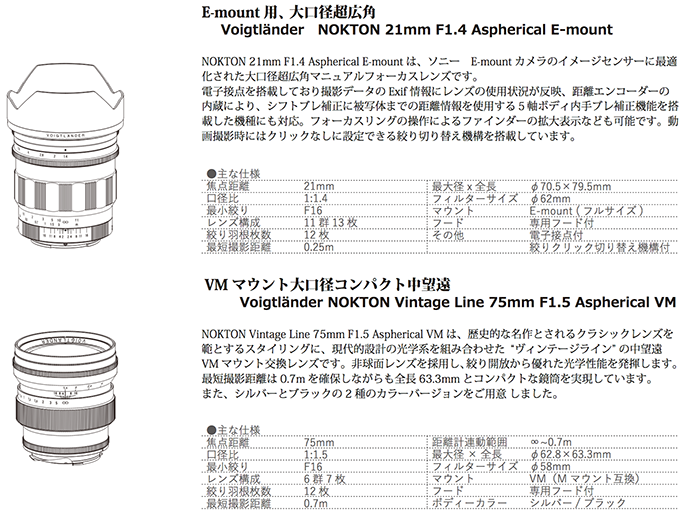
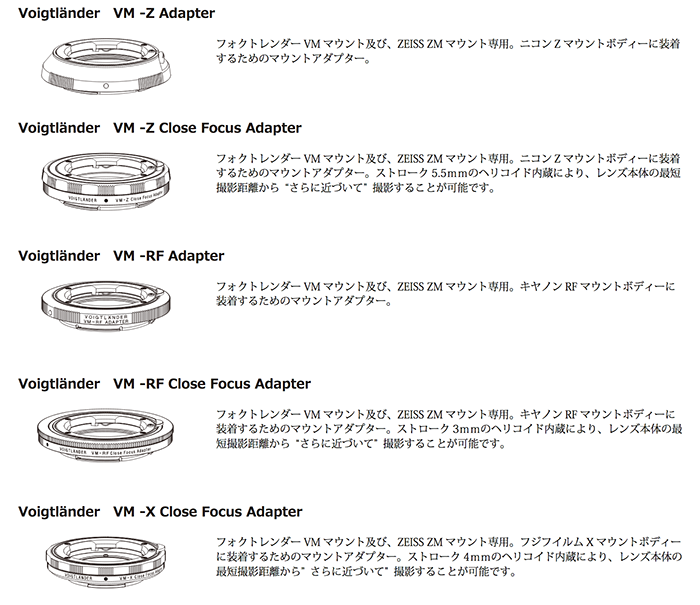
KIPON start to deliver 8 models new 0.7x Baveyes/focal reducer for new Nikon Z mount &Canon R mount cameras, increased Baveyes lineup for using medium format lenses on full frame cameras from 24 to 32 models.


Baveyes Pentax645-Nikon Z 0.7x
Baveyes Pentax67-Nikon Z 0.7x
Baveyes MAMIYA645-Nikon Z 0.7x
Baveyes Hasselblad V-Nikon Z 0.7x
Baveyes Hasselblad V-EOS R 0.7x
Baveyes MAMIYA645-EOS R 0.7x
Baveyes Pentax67-EOS R 0.7x
Baveyes Pentax645-EOS R 0.7x
KIPON Baveyes introduces a lineup of the world’s first lens adapters that bring the famous medium format optics to Sony E, Leica SL and Leica M ,Nikon Z, Canon R 35mm full frame cameras, virtually eliminating any crop factor image loss and maintaining diagonal angle of view.
The transformation results in a 0.7x factor to theoriginal lens focal length with a gain of one stop in lens speed. Foremost in the advanced adapters, is the custom designed five element multicoated formula by German optics research institution, with the ability to use full frame SLR lenses on crop sensor camera bodies and mirrorless cameras.

Many medium format lenses are legendary for contrast, flare resistance, color saturation, bokeh and are in a class of theirown compared to even the best 35mm format glass. And the Sony, Leica ,Nikon, Canon image sensors, in the heart of their robust camera bodies, give new life to these medium format legendary lenses.
The retailer price for these optic focal reducer is 695USD,can order from Amazon Japan and Tmall China and Ebay factory shop from this week.