






Fuji patent discloses a new three layer sensor (Foveon style)

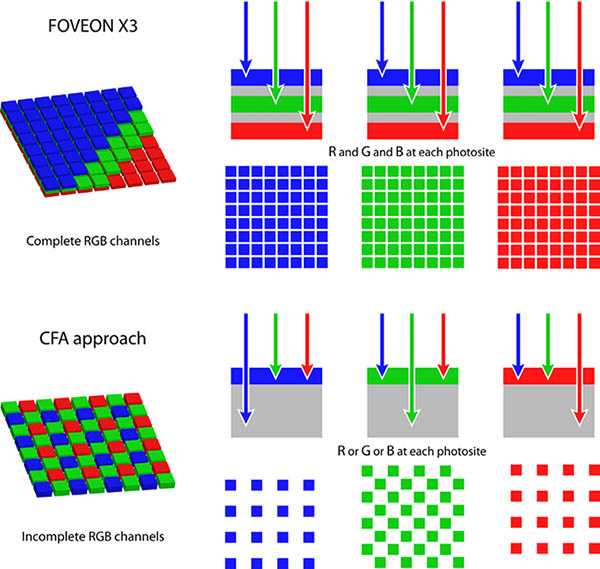
Fuji is very likely to launch a mirrorless system camera in 2012. And it’s also on of the few players (Unlike Olympus, Pentax or Nikon for example) that is producing their own sensors. So you might be interested to see what they are working on. The japanese blog Egami found a new patent (filed in 2009.9.29 and published 2011.4.14) that discloses a new three layer technology very similar to the current Foveon sensors from Sigma. As you probably know the single RGB pixels are arranged vertically one below another. Theoretically the advantages are:
1) no color artifacts
2) More of the photons entering the camera will be detected (larger pixels compared to Bayer sensor)
3) No need for demosaicing and the separate anti-aliasing filter commonly used to reduce the occurrence or severity of color moiré patterns. As a result we have a higher resolution.
Anyway keep in mind. There is a long way to go before a patent gets used inside real products!

Anun
2 years ago |All the three “theoretical advantages” you state are wrong.
1. While there are no demosaicing related color artifacts, there will be more color artifacts caused by light hitting the sensor at an angle.
2. While more photons may be sensed, it is not because of larger pixels, but because of no filter layer on top of the sensor. The pixels are actually likely to be slightly smaller in their light sensitive area.
3. AA-filter will still be needed. While it is not as important as it is on a regular CFA sensor, it is still required unless one is happy with the occasional image ruining aliasing (mostly strong contrast edges, ie. urban photography will be more hazardous w/o an AA-filter).
ph8
2 years ago |AA-filter is not needed! Just look at Sigma.
And AA-filter spoil the image. Its then look like soap.
techDude
10 months ago |You need to go look at Foveon SD1 review. There really is no need for the AA filter on a 3 color sensor, and almost zero color artifacts with nice crisp edges, even at 100% crop. The Foveon has a lot of shortfalls with their implementation, especially the poor camera design, and using silicone to filter the colors makes weird color shifts; but they have shown what is possible by sampling 3 color at each pixel.
Luis
2 years ago |Apparently the previous poster believes he knows more than Sigma and Fuji and Sony , all of whom are investing lots of money in research , patenting fees etc and willing to manufacture a sensor that will use 3 times as much expensive Silicon as a Bayer design for “No reason”.
raist3d
2 years ago |These are not theoretical advantages. The Sigma Foveon proves today that is true.
#1. – nonsense- if the performance I see from my DP2 is anything to go by
#2. Actually yes, the idea is the photosites are bigger due to the fact you can get away with less of them for comparable Bayer resolution. There’s the issue of the three layers though.
#3. No, you don’t need an AA filter. Certainly none of the Sigma Foveons use one. And quite frankly they look better than the usual Bayer pixel by pixel.
johito
2 years ago |though the big disadvantage is greater noise/poorer low light preformance – at least when i was using them….
johito
2 years ago |I think what anun may be refering to in #1 isn’t so much more articfacts but greater chroma noise?
rich
12 months ago |All these camera manufacturers are using silicon to make their sensors, Which is over 15 years old. It’s about time they look else where or create another material to replace it. Just as silicon was replaced with nanotechology for the majority of silicon uses.
Anon
12 months ago |2 raist3d:
#2 WRONG – foveon pixels are large only because they failed to make smaller pixels working